
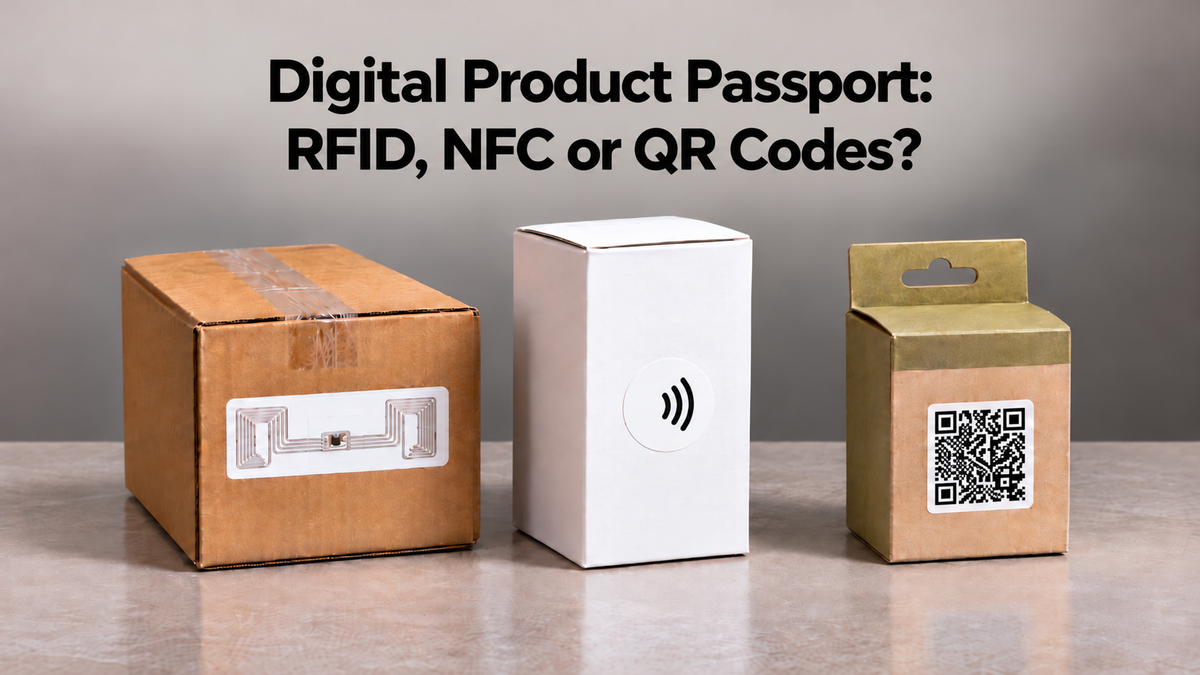
As European manufacturers prepare for Digital Product Passport (DPP) requirements, one practical question is becoming increasingly important: how should a physical product connect to its digital information?
Should businesses use a QR code, an NFC label or an RFID tag?
Each technology can connect products to digital records, but they serve different purposes. A QR code offers straightforward smartphone access, NFC enables close-range interaction, and UHF RFID supports automated identification across warehouses and supply chains.
Choosing the wrong identification method can create difficulties with product accessibility, label durability and operational integration.
For businesses evaluating a digital product passport strategy, the challenge is selecting a data carrier that supports both practical identification requirements and applicable European regulations.
This guide compares RFID, NFC and QR codes, explains their technical limitations, and outlines what European manufacturers should consider before implementation.
What Is a Digital Product Passport?
 A Digital Product Passport is a digital record containing information about a product, its components or its materials.
Depending on the product category and applicable legislation, this information may include:
- Material composition and product origin.
- Sustainability and environmental characteristics.
- Repair and maintenance information.
- Durability and recyclability.
- Information supporting reuse and responsible disposal.
The European Commission's Digital Product Passport framework aims to make relevant product information more accessible throughout the product lifecycle.
A DPP is not simply a QR code or an RFID chip.
The data carrier provides a connection to the product's digital identity. The passport information is managed separately through the relevant digital infrastructure.
For manufacturers, this distinction is essential. Choosing a suitable physical identification technology is only one part of preparing for DPP requirements.
How Do RFID, NFC and QR Codes Work as DPP Data Carriers?
A DPP data carrier is a machine-readable element connecting a physical product to a persistent product identifier and its associated digital information.
Three identification approaches are particularly relevant to manufacturers.
1. QR Codes: Accessible Product Information
A QR code is a two-dimensional barcode that can encode a web address or structured identification information.
For a QR code digital product passport, the user scans the code with a compatible smartphone camera to access the linked product information.
Advantages:
- Widely accessible through smartphone cameras.
- Printable on product labels and packaging.
- No electronic chip required.
- Suitable for consumer-facing product information.
Limitations:
- Requires optical visibility.
- Print quality and surface damage affect readability.
- Manual scanning can be inefficient for large quantities.
- A code printed on disposable packaging may not remain with the product throughout its useful life.
QR codes are a practical option when convenient consumer access is the primary objective.
2. NFC: Tap-to-Access Digital Product Information
Near Field Communication (NFC) is a short-range radio-frequency technology operating at 13.56 MHz.
An NFC digital product passport application can use a compatible NFC label containing a web address or identifier that directs a smartphone to the relevant digital record.
Advantages:
- Enables intentional, close-range interaction.
- Does not require the camera to see a printed code.
- Can be integrated into selected labels and product constructions.
- Suitable for interactive packaging, product information and certain authentication applications.
Limitations:
- Requires an NFC-compatible device and supported tag format.
- Individual interactions are generally needed.
- Performance depends on tag construction and surrounding materials.
- NFC labels cost more to produce than printed-only codes.
An NFC tag is not automatically a secure authentication device. Cryptographic verification requires an appropriate chip and authentication infrastructure.
For businesses evaluating smartphone-compatible identification, TRC offers NFC RFID labels in multiple physical formats.
3. UHF RFID: Automated Supply Chain Identification
Ultra High Frequency (UHF) RFID enables wireless identification using radio waves.
Passive UHF RFID labels contain a microchip and antenna. When energised by a compatible RFID system, they respond with their encoded identification data.
Unlike QR codes, UHF RFID does not require a direct optical view of the label.
This makes it useful for identifying multiple products during warehouse receiving, stocktaking, production and distribution.
Advantages:
- Supports identification of multiple tagged items.
- Reduces dependence on individual optical scans.
- Can support product-level traceability across operational checkpoints.
- Enables integration with existing inventory identification processes.
Limitations:
- Standard smartphones cannot ordinarily read UHF RFID tags.
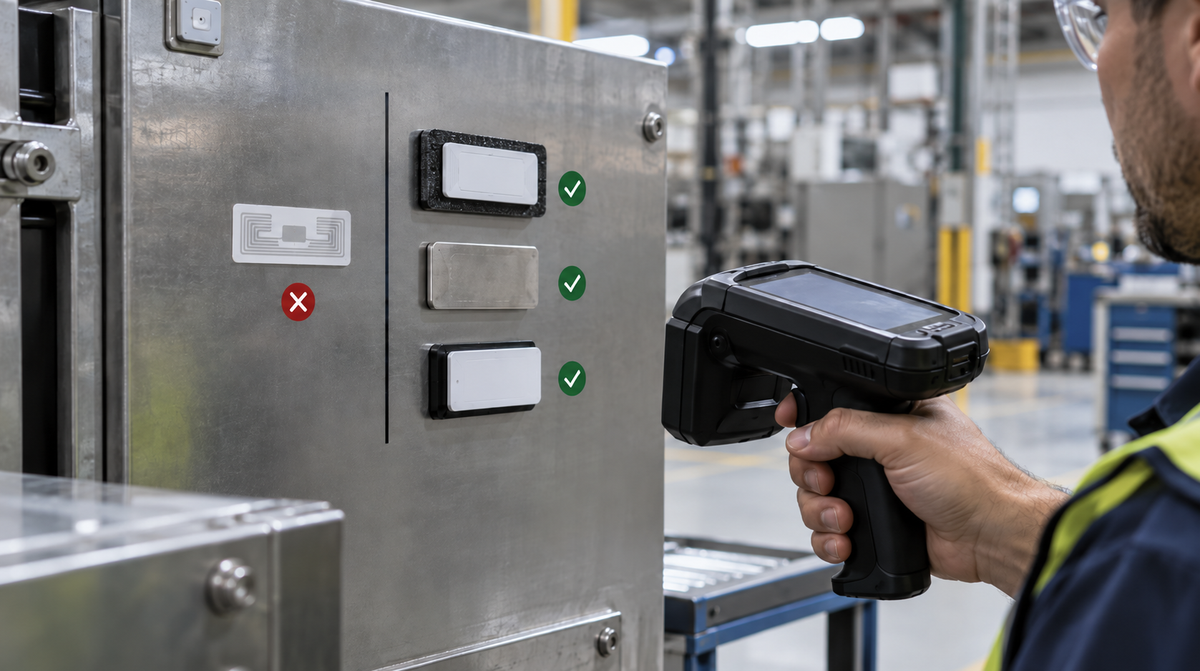
- Metal, liquids, orientation and dense packaging can affect performance.
- Requires compatible reading infrastructure.
- A UHF EPC identifier may need to be resolved to the corresponding passport record.
UHF RFID is therefore particularly relevant when manufacturers want their identification labels to support operational traceability alongside digital product information.
Explore TRC's UHF RFID labels for manufacturing, warehousing and inventory applications.
RFID vs NFC vs QR Code: Which Is Better for Digital Product Passports?
There is no universally superior DPP data carrier. The best approach depends on the product, its operating environment, who needs access and the applicable requirements.
| Selection Factor | QR Code | NFC | UHF RFID |
|---|---|---|---|
| Reading method | Camera-based | Short-range radio | UHF radio |
| Smartphone accessibility | Broad | Compatible NFC phones | Generally requires dedicated equipment |
| Line-of-sight requirement | Yes | No optical line of sight | No optical line of sight |
| Bulk identification | Limited for typical manual scanning | Generally unsuitable | Well suited |
| Electronic chip | No | Yes | Yes |
| Main strength | Accessible product information | Close-range interaction | Operational traceability |
| Main constraint | Print visibility and durability | Device compatibility | Infrastructure and environmental sensitivity |
Practical recommendation:
Choose QR codes when accessible product information is the primary objective. Consider NFC for deliberate smartphone interactions. Consider UHF RFID when the same product also needs automated identification in manufacturing or logistics.
Actual regulatory acceptance must be checked against the applicable product-specific rules.
Can Manufacturers Combine RFID and QR Codes?
Yes. Using more than one data carrier can be sensible when different users need different identification methods.
Consider a hypothetical European clothing manufacturer.
During production and distribution, UHF RFID labels could support identification of garments as they move between operational checkpoints.
After purchase, consumers may prefer to access product information using a smartphone.
The manufacturer could therefore combine:
- A UHF RFID identifier for logistics and inventory operations.
- A QR code for consumer-facing access to product information.
Both identification methods can be associated with the same underlying product identity, provided the identification and data-resolution systems are designed correctly.
This approach can support operational efficiency and accessible product information without expecting one technology to perform every function.
However, adding a second carrier introduces extra material, application, encoding and verification requirements. It should be justified by the use case rather than added automatically.
For a deeper technical comparison, read UHF vs NFC: What's the Difference and Which One Should You Use?
What Does the EU Require for Digital Product Passport Data Carriers?
The EU Digital Product Passport framework is established under the Ecodesign for Sustainable Products Regulation (EU) 2024/1781.
Under Articles 9 and 10, DPP requirements include a connection between the passport and a persistent unique product identifier through a data carrier.
The relevant product-specific rules determine matters such as:
- Which data carriers may be used.
- Where the carrier must be placed.
- Which information must be included.
- Whether the passport operates at model, batch or individual-item level.
These provisions are described in the official ESPR regulation.
Importantly, the ESPR framework does not establish a universal requirement to use RFID for every product.
Implementation is progressive. Certain battery categories have DPP obligations beginning on 18 February 2027, while detailed ESPR requirements for textiles are still being developed as of October 2026.
Why Do GS1 and European Standards Matter?
GS1 Digital Link provides a standardised way to represent product identifiers in web addresses so that physical identification can connect to online information.
For example, a compatible QR code can contain a GS1 Digital Link address. An NFC label can also carry an appropriate web address, while UHF RFID systems may need to translate the encoded identifier into the corresponding digital reference.
European DPP standards additionally address identification and interoperability. These include EN 18219 for unique identifiers and EN 18220 for data carriers, as described by CEN-CENELEC.
Manufacturers should confirm the applicable standards and delegated acts before claiming their labels provide DPP compliance.
How to Select RFID or NFC Labels for DPP-Related Applications
Selecting the right identification label involves more than choosing a frequency or chip.
Procurement managers and system integrators should evaluate the following requirements.
1. Identify the Product Surface
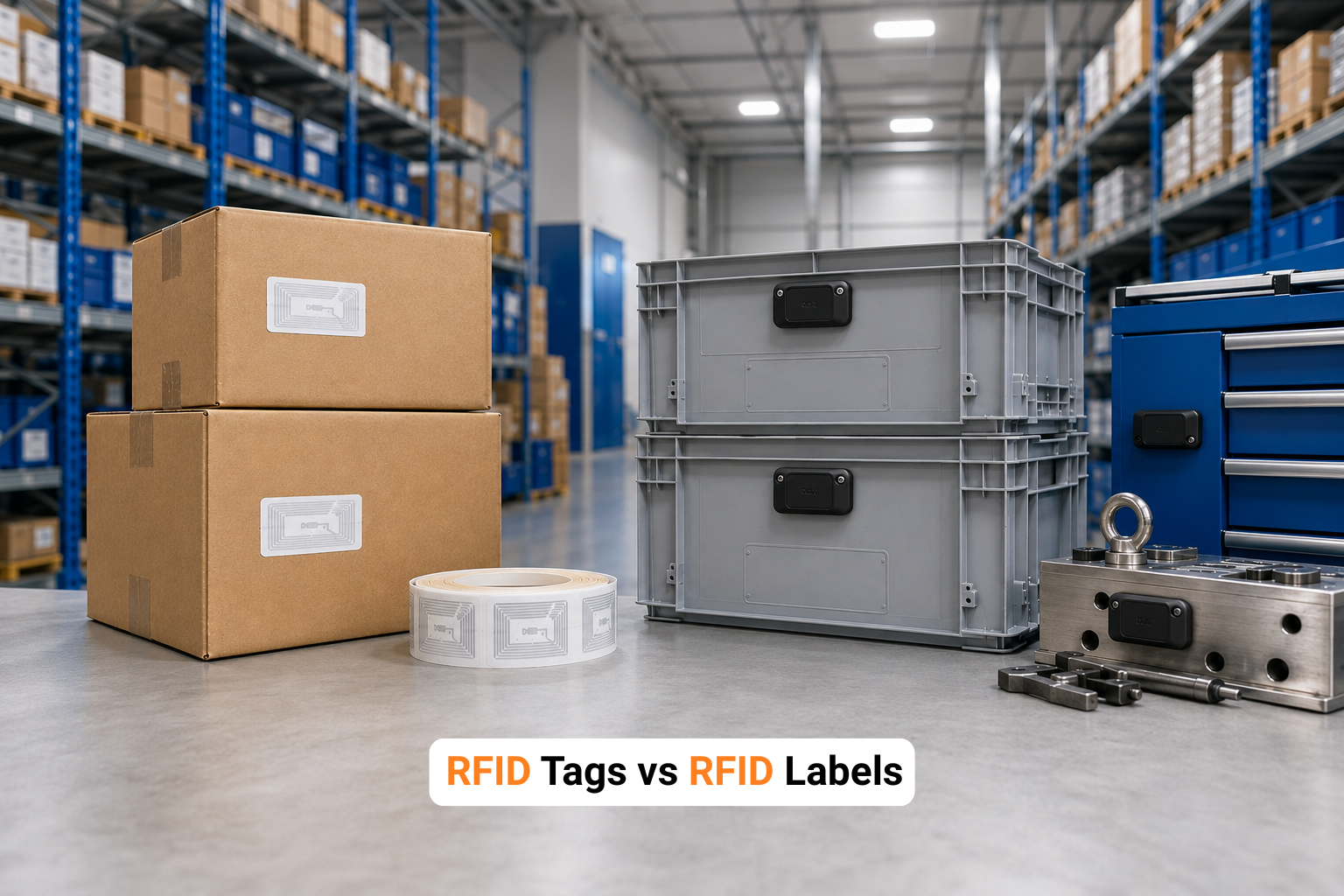
Labels behave differently on cardboard, plastic, textiles and metal.
Metal can interfere with conventional RFID antenna performance. For metallic equipment and components, consider specialised on-metal RFID labels.
2. Define the Expected Product Lifetime
Consider whether the label must withstand washing, abrasion, moisture, chemicals, temperature changes or repeated handling.
A label suitable for disposable packaging may not be appropriate for a reusable industrial component.
3. Confirm Identification and Encoding Requirements
Specify whether the application needs identification at product-model, batch or individual-item level.
For UHF RFID, determine the encoding scheme and identifier mapping. For NFC, check the chip type, available memory, supported protocols and smartphone behaviour.
The selected identification data must remain consistent with the associated product record.
4. Check Physical Placement and Accessibility
A label can function technically but still be unsuitable if users cannot reach or read it.
Consider installation position, neighbouring materials, packaging, likely product handling and whether the carrier will remain attached.
5. Test Samples Before Large-Scale Procurement
Pilot testing should assess:
- Readability on the actual product.
- Performance under expected environmental conditions.
- Encoding correctness and identification uniqueness.
- User access to the linked digital information.
- Performance after relevant ageing, cleaning or handling tests.
These checks help distinguish a label that works in a laboratory from one suitable for the intended application.
Key Takeaways
- QR codes offer accessible digital information, especially when smartphone access is the main requirement.
- NFC supports controlled product interaction, provided tag and device compatibility are verified.
- UHF RFID supports operational traceability through automated identification across supply-chain processes.
- Dual-carrier designs can be useful, but all carriers must connect consistently to the appropriate product identity.
- EU compliance depends on applicable legislation, not simply on whether a product contains an RFID or NFC label.
Frequently Asked Questions
Is RFID mandatory for Digital Product Passports in Europe?
No. The ESPR does not mandate RFID universally. Specific DPP data-carrier requirements depend on the applicable product legislation and delegated acts.
Can an NFC label link directly to a Digital Product Passport?
Yes. A compatible NFC label can store a web address or other suitable reference connecting users to digital product information. This does not automatically establish regulatory compliance.
What Is the Difference Between RFID and NFC in DPP Applications?
NFC is a form of high-frequency RFID commonly used for close-range interactions. UHF RFID is more suitable for automated identification of multiple products in operational environments.
Can an Existing UHF RFID Tag Be Used for a Digital Product Passport?
Potentially. Its identifier can be associated with a DPP record, but the encoding, mapping and accessibility arrangements must be checked. An existing UHF tag alone does not necessarily satisfy the relevant DPP data-carrier requirements.
Should Manufacturers Choose One Data Carrier or Combine Technologies?
Start with the intended users and identification requirements. One carrier may be sufficient for a straightforward consumer-facing application. Multiple carriers may be justified when automated logistics and smartphone access are both required.
Conclusion: Choose the Data Carrier Around the Product
RFID, NFC and QR codes can all play a role in connecting physical products to digital information.
The right choice depends on more than technology preference. Manufacturers must consider how products are identified, how long labels need to function, who needs access and which regulatory requirements apply.
For European companies preparing for Digital Product Passports, the most effective approach is to establish the identification and data requirements before selecting the physical label.
Looking for RFID or NFC labels suitable for your product identification application? Explore The RFID Company's label range or contact our team to discuss your technical requirements.

Share:
Why Standard RFID Tags Fail on Metal, and What to Test Instead?