
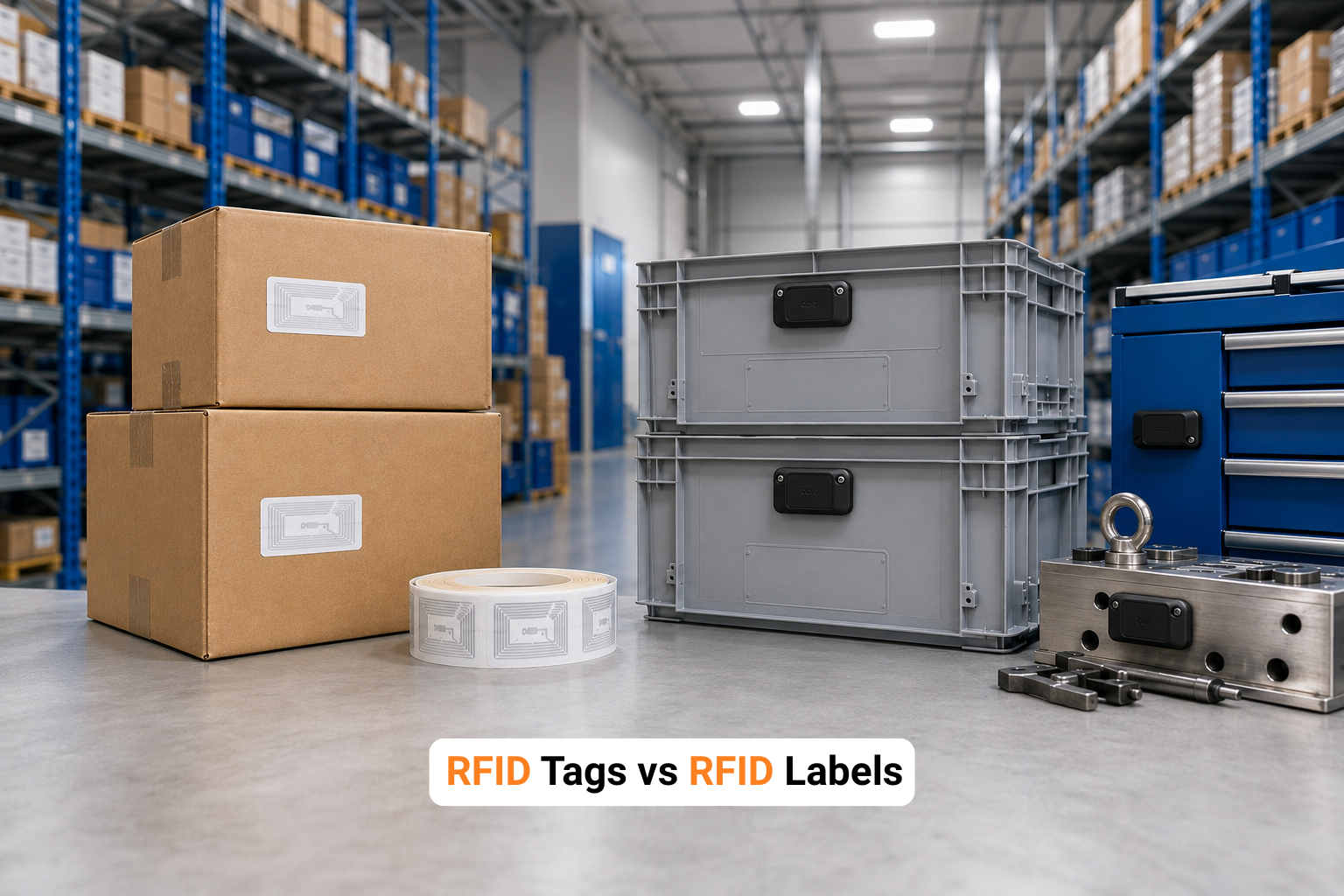
It is quite common for people to confuse RFID tags and RFID labels as one and the same. They are similar but are sometimes not interchangeable.
In fact, both allow you to wirelessly recognise and locate the tagged objects. However, their design, durability, price, and best applications can vary. Inappropriate selection can influence the readability, longevity, and overall success of your project.
For instance, a label will perform fine when applied to the carton box but won't do a good job with the metal assets or reusable containers.
What is an RFID Tag?
An RFID tag is a unit that holds data and transmits data to an RFID reader. This device will usually consist of an RFID chip and an RFID antenna. The RFID chip stores the data, and the RFID antenna allows the data to be transmitted over radio waves.
The definition of RFID tags is very general. RFID tags may include hard tags, labels, cards, bracelets, laundry tags, or RFID tags for metal.
RFID tags are most often used by businesses requiring reliable means of identification for their assets, equipment, tools, containers, machinery, and other industrial items.
What are RFID Labels?
RFID labels are mostly thin adhesive labels with an RFID inlay embedded in them. RFID inlays consist of the RFID chips and antennas, while the exterior may be printed with texts, bar codes, QR codes, logos, product information, or serial numbers.
RFID labels find their applications in products, cartons, pallets, packaging, inventory, and logistics. RFID labels are applied like regular adhesive labels, which makes them appropriate for high-volume applications.
For instance, UHF RFID labels are used in warehouses and in the supply chain to rapidly identify many products without manually scanning bar codes.
RFID labels are comparatively cheaper than RFID hard tags, but they might not suit all surfaces or environments.
RFID Tags vs RFID Labels
The major difference is that all RFID labels are RFID tags, but not all RFID tags are RFID labels.
An RFID label is typically a format in which you can print on and make use of an adhesive. It is meant to be printed and used for applying to goods, cartons, packaging, and inventory.
On the other hand, an RFID tag is a much wider term that can be defined as a hard tag, rugged tag, embedded tag, washable tag, wristband, card, tag for metal surfaces, and many other types of tags.
Basically, the distinction is made depending on form, durability, and application. The former refers to thin and printable material for use in large quantities. The latter involves different options like durable or reusable tags for particular surfaces.
When printing, adhesive properties and price efficiency are important factors to consider; then go for an RFID label. If durability and strength play a more significant role, use RFID tags.
When Should You Use RFID Labels?
RFID labels are helpful when a business needs a simple method to print and scale up for identifying their products or packaging. RFID labels are common for RFID-based inventory management systems, logistics, retail, manufacturing, and supply chain activities.
RFID labels can be employed in situations when product-level identification, carton identification, pallet identification, warehouse inventory management, packaging, or printed data is needed.
They are effective in use with cardboard, paper, plastic packing, and other non-metallic surfaces.
In the case of high-volume production, RFID labels can be printed, programmed, and affixed as part of the labelling procedure.
When Should You Use RFID Tags?
RFID tags are preferable when any consideration about toughness, adhesion, environmental resistance, or longevity is involved.
They are used often for RFID asset tracking, industrial tracking, reusable products, or special surface RFID tagging.
Common examples of RFID tags include tools, machinery, fixed assets, metal surfaces, outdoor products, reusable transport products, laundry, textile identification, and industrial containers.
In particular, reusable plastic crates can require more robust RFID products compared to standard adhesive stickers. For example, RTI labels or tough RFID tags are more appropriate in this situation.
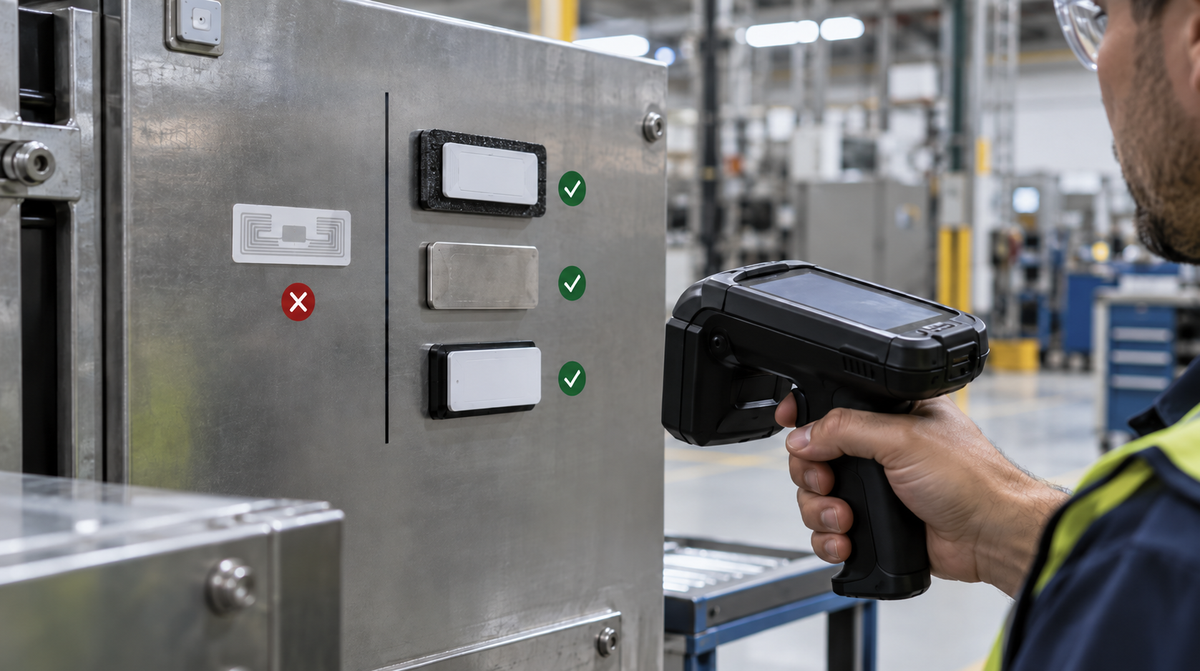
The same applies to metallic tools and equipment, which will require the application of on-metal RFID tags because standard RFID stickers do not perform well on metals.
Cost Difference Between RFID Tags and RFID Labels
RFID labels are generally more economical in higher-volume cases. That is why they are widely used for packaging, cartons, stock control, and product labeling.
Hard RFID tags tend to be more expensive because they might consist of stronger casing, special materials, better protection, or mounting facilities. There are RFID tags that can endure exposure to heat, water, impacts, chemicals, or external environments.
Nevertheless, the least expensive solution is not necessarily the best solution. An inexpensive RFID label can prove itself quite suitable for a carton label, yet it may easily fail when applied to a metal object, an outdoor container, or a reusable item.
The true cost involves tag cost, read performance, failure rate, installation technique, replacement costs, and the value of the item labelled.
Read Range and Performance Differences
The read distance of an RFID tag depends on the RFID frequency, antenna, size, power, material of the item, and environmental conditions.
RFID tags normally work well on cardboard, plastic packaging, paper products, and other regular inventory items. But metal and liquid can affect the performance of RFID technology.
Normally, when an RFID tag is put on metal surfaces, it won’t function properly because it is not designed to do so. In case of metal assets, companies need to think about on-metal RFID tags or labels.
How to Choose Between RFID Tags and RFID Labels
Prior to deciding on whether to use RFID labels or RFID tags, companies need to consider the requirements of their tracking application first.
Consider these questions:
- Which object do you want to tag?
- Is the object single-use or multi-use?
- Is the material of the object made of metal, plastic, cardboard, glass, fabric, or liquid-filled containers?
- Do you require the label to be printable?
- What is the required read distance?
- Will the tracking last days, months, or years?
- How many objects need to be tagged?
Common Mistakes Businesses Make
One mistake that people make is to select RFID labels simply due to their lower price. It could lead to problems when such a label is applied in a wrong environment.
Another error is to use standard RFID labels on a metal surface directly without special adjustments, since metal could affect the performance of the RFID technology.
Mistakes also include lack of read range testing, ignorance of the attachment method, incorrect selection of the antenna configuration, and usage of the same RFID product for all applications.
Conclusion
While RFID labels and RFID tags offer ways to recognise and trace items without wires, they have specific applications.
RFID labels are often used for printable, adhesive, and bulk applications like packaging, cartons, pallets, items, and inventory tracing.
On the other hand, RFID tags suit the purposes of durable, reusable, industrial, or special surface applications such as metallic items, tools, equipment, laundry, and reusable transportation items.
The decision is based on the type of item, its surface, environment, required read distance, life cycle, and application procedure. Businesses need to test the RFID product before the full implementation under real-life conditions.
Businesses can find various RFID Tag, RFID label tamper-proof RFID labels, on-metal tags, RTI labels, and application-specific RFID solutions at The RFID Company.
FAQs
1. Do RFID tags and RFID labels represent one and the same thing?
To some extent, yes. An RFID label is just one type of RFID tag that also includes RFID hard tags, RFID cards, RFID wristbands, laundry RFID tags, etc.
2. Which one is better: RFID tags or RFID labels?
None of them is better all the time. RFID labels suit printable or high-volume applications. RFID tags are better for durable, reusable, or industrial applications.
3. Can RFID tags work on metal?
Standard RFID labels will typically not work well on metal. You need on-metal RFID tags or on-metal RFID labels.
4. Can RFID labels be printed?
Yes, they can be. Most RFID labels are printable with a barcode, QR code, product information, serial number, logo or human-readable text.
5. Which costs less?
RFID labels are more cost-effective for high-volume applications. RFID tags are more expensive but have a longer lifespan in harsh environments.
6. How to choose RFID technology correctly?
It depends on the object you will tag, its surface material, environment, read range, lifetime, and possibility of printing.

Share:
RFID Inlay vs RFID tag vs RFID Label: What European Businesses Need to Know
How to Reduce Inventory Mistakes with RFID: A Simple 2026 Guide for Warehouses