
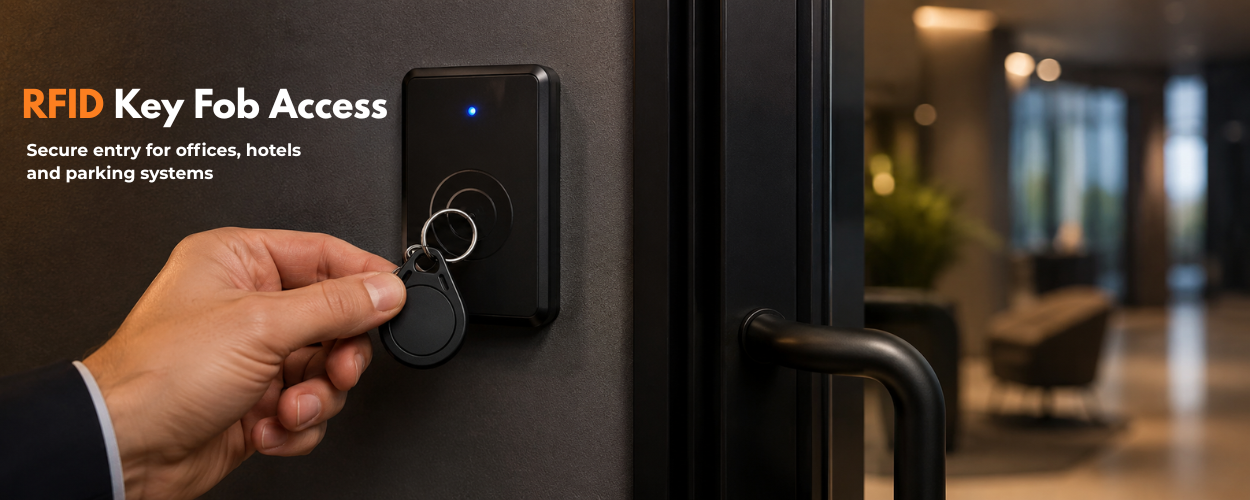
What does an RFID key fob do?
An RFID key fob is a small access device that uses radio frequency identification (RFID) technology to open doors, gates, lockers, hotel rooms, parking barriers and other secure areas. The user taps the fob up to an RFID reader instead of inserting a metal key. The reader checks the stored ID and decides if access should be permitted and then opens the door or system.
RFID key fobs have gained popularity because of their simplicity, small size and ease of management. You may have seen them in hotels, offices, apartment buildings, gyms, parking lots, warehouses and other restricted business areas. They are also used when tracking and controlled access is important.
Many industries use the same RFID concept. Retail RFID tags, for example, identify products, improve stock visibility and reduce manual scanning. RFID fobs work much the same way in access control, except instead of identifying products, they identify people, users, vehicles or access permissions.
The term 'RFID tags' is often used in RFID systems to refer to the small chip-based items containing unique identification data. An RFID key fob is a type of RFID tag used mainly for personal access and security.
How Does an RFID Key Fob Work?
The RFID fob is made up of two main parts that work in conjunction: the fob itself and the RFID reader.
The fob has a small RFID chip & antenna on it. The reader sends out a radio signal. When within range of the fob, it responds with the ID number stored in it. The access control system then checks that number against the database.
If your ID is approved, voilà, you’re in. If the ID is not approved, the door or barrier remains locked.
Most RFID key fobs for access control are passive. So they don’t need a battery. They draw power from the reader’s signal for a very short time, just long enough to send back their ID.
They are easy to care for and good for everyday use. They don't need to be charged by the user; they don't run out of batteries, and they don't have any buttons to press. They just tap and type.
RFID fobs operate at different frequencies depending on the system. Common access control fobs are based on low- or high-frequency technology. The right choice depends on the reader, the level of security, the distance of reading and the environment.
It is like the retail RFID tags needing to match the right reader and use case. A clothing inventory tag does not always make sense for access control, and an access fob does not always make sense for product tracking. The selection of the right type of RFID tag is very crucial for the reliable performance of RFID applications.
Common Application
RFID key fobs are used in all cases where access control, monitoring or simplification is necessary. “They are good for companies that want to decrease physical key management and increase security.”
Hotels
Hotels employ RFID key fobs or RFID cards for access to their guest rooms. Rather than providing metal keys for guest rooms, the hotel issues the guests with a particular fob or card that operates within a single room.
Hotel access is made more efficient through the implementation of RFID technology. In the event that the fob gets lost by the guest, the hotel would deactivate it and provide another fob. The old one doesn't necessitate any action, such as changing the door lock system.
Furthermore, the RFID technology can be used for employee access to designated places within the hotel facility, such as storage, elevators, staff parking spaces, housekeeping, etc. Permissions may vary for users based on their positions.
The implementation of RFID technology not only benefits the hotel management but also the guests, as the process is made convenient, modern, and fast.
Office
Offices are among the locations that are most frequented by RFID key fobs. They allow the firm to have control over who accesses their offices, such as the main entrance, meeting halls, server room, warehouses, and special workspaces.
With normal keys, there is no way to tell whether the employee has entered the room. By using RFID, the firm has an opportunity to document digital access records.
Another reason for using the RFID key fob in offices is that of changes in the employment status of the employees. It allows the firm to make changes to employee access privileges in the system.
When the firm needs more control, for instance, with larger offices, the RFID key fob can be linked to systems such as time tracking, lift access, and visitor management.
The above process of identity verification is applied across several business scenarios. Some examples include product tracking using RFID tags at retail locations and asset tracking using RFID tags within RFID systems.
Parking Systems
The RFID key fobs can also be used in the parking system, where drivers will use the fob to open a gate, barrier, or garage door or even enter into restricted parking zones.
This application can be seen in offices, apartment buildings, hotels, warehouses, hospitals, and many others. In such a case, an RFID key fob is issued only to one particular car owner, employee, resident, or visitor.
The parking entrance is quicker since there is no need to make a stop at a manual security point. There is automatic recognition of the RFID fob through a special system.
The use of the RFID system in the parking area makes the process quick, efficient, and easier to manage for companies and other organisations.
Type of RFID key fobs
RFID key fobs are of various types according to the access system and the application environment. Choosing the right kind is important. Not all fobs will work on all readers.
Simple access control systems prefer the use of low-frequency RFID fobs. They usually have a shorter read range and are used for simple door entry applications.
Also in high demand are high-frequency RFID fobs for access control. Depending on the chip type and system, they can offer better security features. In some places, you’ll see higher frequency fobs where stronger authentication is required.
High-frequency RFID fobs are also referred to as NFC-enabled fobs. NFC is generally used for short-range communication. It can work with some smartphones or NFC readers, depending on the configuration.
Encrypted RFID fobs are for high-security applications. These fobs are more than just an ID number. They can be used in secure communication techniques to reduce the probability of copying or cloning.
RFID key fobs can be made in a variety of shapes, colours, materials and branding styles to suit your needs. Companies can also opt to have custom key fobs made that reflect their branding, department structure or user groups.
Like RFID tags for retail, RFID fobs should be chosen based on the use case, reader compatibility, durability and performance required. The term 'RFID tags' in RFID sounds generic, but it actually covers a variety of product forms ranging from labels and cards to fobs, wristbands and industrial tags.
Benefits over traditional keys
RFID key fobs offer several benefits over traditional metal keys.
The key advantage is easier control of access. Losing a metal key can be a serious security risk. The lock will need to be changed very often. With an RFID fob, you can easily remove the lost fob from the system.
Another benefit is better control. Businesses can control who has access to what. For instance, an employee may be able to access the main office, but not the server room. A cleaner may be available only at certain times.
RFID fobs also produce useful logs. They can tell you who went into a specific area and when. This is good for security checks, investigation and internal control.
Also, they are more practical for daily use. Users do not have to carry a bunch of keys. You can program one fob to open multiple authorised zones.
RFID fobs can also save you money in the long run. The access control system may need some initial setup, but it is easier to manage users over time. Fewer physical key copies, lock changes and manual access management.
It also responds quickly in busy environments. A quick tap beats searching for the right key. It is essential for offices, hotels, parking systems, and high-traffic areas.
RFID is a trusted technology that is already in many sectors. Retail RFID tags help stores keep track of products. Access fobs help businesses keep track of people and entry points. Both are examples of RFID systems that can minimise manual work and increase visibility with RFID tags.
Choosing the right RFID Key Fob provider
The key is selecting the right RFID fob provider. Reliability is the basis of access control. A substandard fob may not read properly; it may fail early, or it may not be compatible with your system.
The first thing to look for is reader compatibility. Your supplier will need to know the frequency of your current system, the chip type, and the format. If the fob doesn't work with the reader, it might just not be working.
The second is security. A simple fob will suffice for easy access. Secure/encrypted fobs may be better suited for offices, hotels or restricted areas. A good supplier should be able to guide you according to the risk levels.
Durability is important, too. People use RFID key fobs on a daily basis. It is drop-proof and can be carried on a key ring, in the elements, or under rough conditions. Material and construction quality should be appropriate to the environment.
Customisation can be useful as well. Businesses might want to print logos, numbering, colour coding or different designs of fobs for different departments or user groups.
A good supplier should also allow for testing before big orders. A small sample test will confirm that the fob works properly with your current readers and access control software.
We adopt the same approach when selecting retail RFID tags for inventory or product tracking. Testing is important as every environment is different. Metal, liquids, distance, reader type and system setup can affect performance. The same is true for other RFID tags in RFID applications.
If you’re a business planning a new access control system, it pays to choose a supplier who understands both RFID products and real-world implementation. It’s not just about buying fobs; it’s about making sure they work perfectly in your everyday business.
Conclusion
RFID key fobs present a straightforward yet effective solution to facilitate access control management. The technology enables quick access management and minimises key loss issues while providing better control of access to particular premises by businesses.
They apply to many scenarios, including hotels, offices, parking access control solutions, and restricted zone access management, among others. They represent only one aspect of a broader RFID network in which various tag types play different roles. Retail RFID tags provide visibility to goods, whereas RFID tags for access management systems allow identification of users.
To get the maximum from their use, businesses need to pick RFID fobs that fit well and are safe to use, reliable and durable under actual conditions. This will require an experienced RFID supplier that will provide assistance in testing and selecting the appropriate key fobs.
FAQs
1. What is an RFID key fob?
Secure access control is done using an RFID key fob. It can communicate with an RFID reader to open doors, gates, lockers, hotel rooms, parking barriers and restricted areas.
2. Need a battery for the RFID key fob?
The majority of RFID key fobs used for access control are passive, meaning they do not need a battery. Placed near the RFID reader, they power up from the reader’s signal.
3. Can RFID key fobs be cloned?
Some basic RFID fobs can be cloned if they use older or less secure technology. More secure fobs use encryption or advanced authentication to reduce the chance of duplication.
4. RFID Card vs RFID Fob: What’s the Difference?
The form is different, but they both function similarly. An RFID card is similar to an ID card; an RFID fob is smaller and usually attached to a keyring.
5. Are RFID key fobs the same as RFID tags used by retailers?
They are not the same. They are using similar principles to RFID. Retail RFID tags are generally used for tracking products, whereas RFID key fobs are generally used for access control.
6. Why are RFID tags important in RFID systems?
In RFID systems, RFID tags hold identification data that readers can detect. Without the tag, the system does not know what item, person or object it is that is being tracked or approved.
7. How to choose the right RFID key fob?
Select an RFID key fob that is compatible with your reader's compatibility, frequency, chip type, security level, durability and access control needs. Always suggest testing a sample before you order in bulk.

Share:
RFID Tag for Apparel: How It Works, Benefits, and How to Choose the Right Solution
How to Choose UHF RFID Labels: Read Range, Surface & Applications