
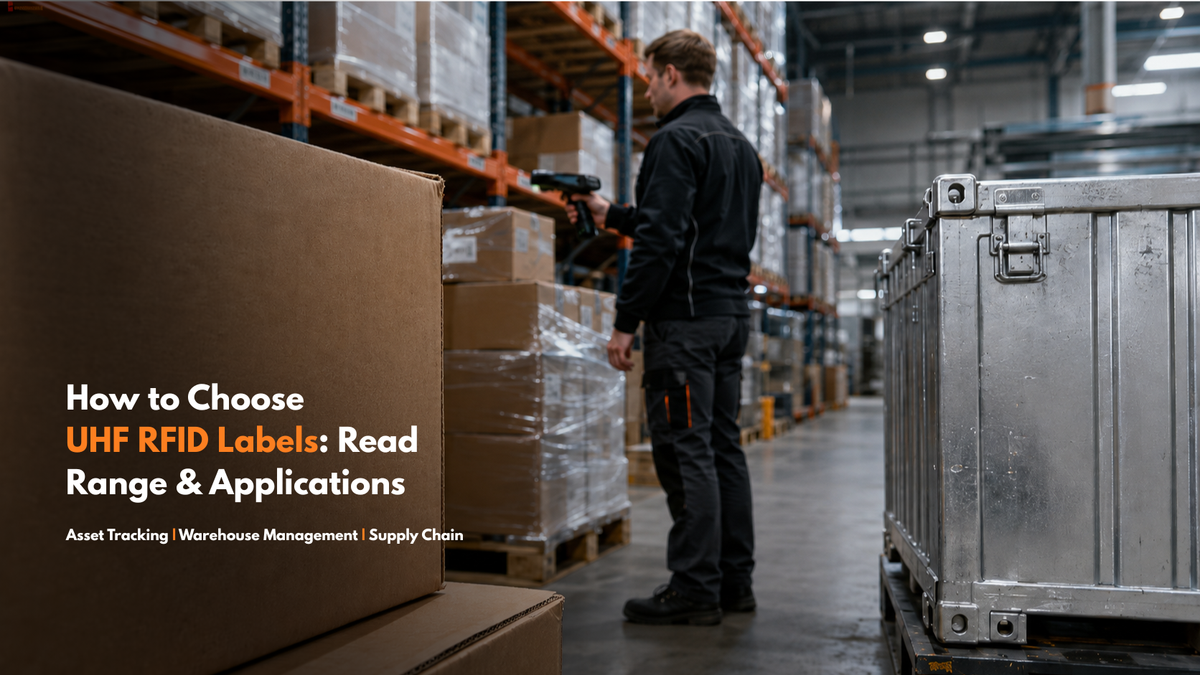
Choosing a UHF RFID label is not simply a matter of selecting a size or chip. The correct label depends on the surface being tagged, required read distance, operating environment, frequency requirements, adhesive, printing requirements and how RFID data will be used within the business.
This guide explains the main factors to evaluate before selecting a UHF RFID label for inventory, logistics, asset tracking and warehouse applications.
If you already know the specification you require and want to compare available products, browse our UHF RFID labels.
What Should You Consider Before Choosing a UHF RFID Label?
UHF RFID labels are labels that use radio frequency to identify and track items. They do this without needing to see the items. This is different from a barcode, which needs to be scanned one at a time. A UHF RFID label can be read by a reader from far away, even when the item is moving or is inside a box or on a shelf.
UHF means Ultra High Frequency. In Europe, UHF RFID systems usually work on a frequency from 865 MHz to 868 MHz. There is also another frequency from 915 MHz to 921 MHz that is used for UHF RFID equipment as specified by ETSI EN 302 208. UHF RFID labels are really useful for managing items. UHF RFID systems make it easy to track UHF RFID labels. The standard defines technical characteristics for RFID equipment and power limits for these frequency bands.
For European businesses, UHF RFID labels are especially useful in logistics, retail, manufacturing, healthcare, asset management and supply chain operations. They help companies move from manual checking to automated visibility. Instead of asking, “Where is this item?” Businesses can identify, locate and count tagged products or assets much faster.
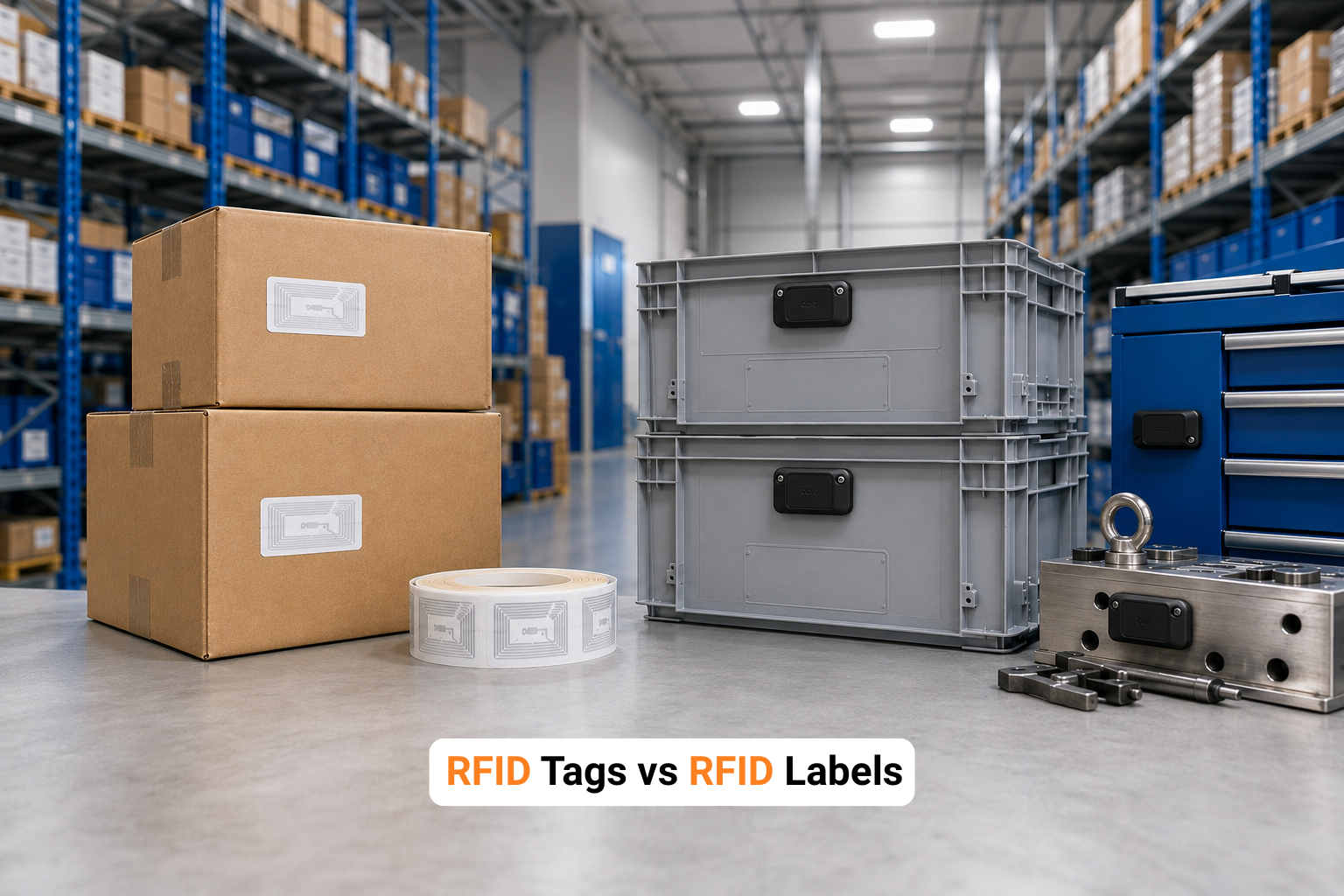
A UHF RFID label/tag consists of three elements. The chip, which contains the data, the antenna, which connects to the reader, and the printable face on which data can be printed. Such information may include the product name, a barcode, a serial number or even corporate logos.
How does UHF RFID work?
 The working principle of UHF RFID technology is the communication process between the tag and the reader. The reader transmits the radio frequency waves via its antenna. When a UHF RFID label gets into the reading range, it gets energised by the radio frequency wave and transfers its information.
Generally, most UHF RFID labels are passive. As such, they do not use batteries since their power comes from the RF signal of the reader itself. This type of tag is affordable and convenient to use in bulk operations.
Passive UHF RFID systems usually refer to RFID technology. 'RFID' is an abbreviation of 'Radio-Frequency Identification' networks. It uses the ISO/IEC 18000-63 air-interface protocol that is also called GS1 UHF Gen2. Standardisation becomes crucial in order to ensure compatibility of RFID equipment from various vendors.
This process works out in the following way:
-
A UHF RFID label is placed on the item, product, box, pallet, or asset.
-
An RFID reader uses one or more antennas to transmit signals.
-
Then the UHF RFID label gives out its unique identification code.
-
After that, the RFID software will link this identification code with the business data, like product type, location, availability, ownership, etc.
That is why UHF RFID labels cannot be simply termed “tags”. These turn out to be a digital link between real-world objects and enterprise applications like ERP, WMS, inventory systems, or asset management solutions.
Where Are UHF RFID Labels Used?

Asset tracking
The use of asset tracking for business purposes is among the top applications of UHF RFID labels. Businesses can apply these labels to laptops, devices, machinery, medical instruments, transport packages, furniture, containers, and other expensive equipment.
This technology allows the use of RFID gate readers or RFID handheld readers to scan and locate various assets without having to check each one manually. In turn, asset loss, auditing inaccuracies, and other issues can be easily avoided.
A good example would be the use of UHF RFID labels by a manufacturing company to track equipment and spare parts within its premises. These pieces of equipment may be automatically tracked whenever they are moved from one department to another.
Warehouse management
UHF RFID labels can enhance the process of receiving, picking, packing, stocktaking, and dispatching goods in a warehouse setting. The use of UHF RFID allows a warehouse crew to scan several cartons or pallets simultaneously rather than scanning each barcode separately.
It is beneficial for companies that work with large quantities of items. In such a case, RFID readers will allow verification of what has been delivered. comparing the received products with purchase orders and adjusting inventory levels quickly.
Using UHF RFID labels will also allow for implementing cycle counts efficiently. It means that it will no longer be necessary to close down warehouse sections to manually count inventory but instead do so with the help of portable scanners.
If the warehouse is located in Europe and services multiple countries, the technology will allow tracking the origin of the products and their movement throughout the facility, storage place, and dispatch.
Supply chain
Visibility is key in any supply chain operation. UHF RFID labels can assist businesses in identifying products, cartons, pallets, and even returnable packaging along various supply chain touchpoints.
The product manufacturer can attach tags to products before shipping. The logistics provider can scan the pallet before or after loading. The receiving centre will be able to validate the incoming products. Finally, the receiver, whether a retailer or an industrial firm, can verify receipt of deliveries without opening every package.
Thus, a much smarter and more efficient supply chain is facilitated by using RFID. The process of manually inputting information into systems will not be necessary anymore, as the data at a unit or even case level can be automatically collected.
Do You Need Standard or On-Metal RFID Labels?
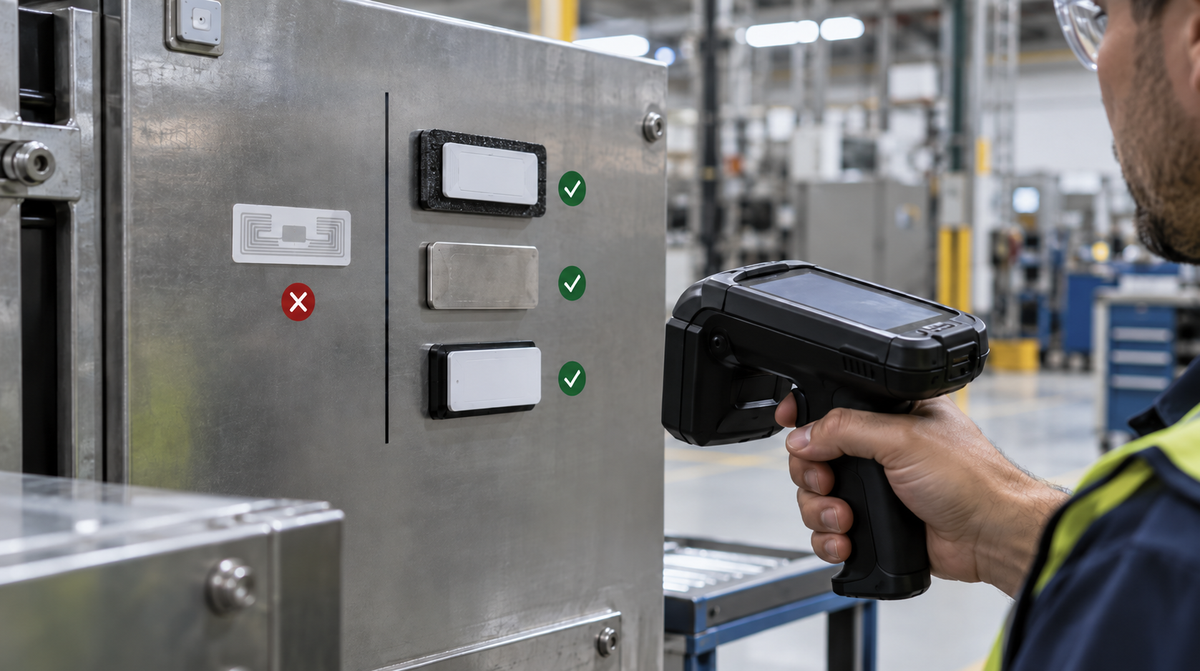
The normal UHF RFID tags may not have a good performance when stuck directly on metal surfaces due to the nature of metal interfering with the radio frequencies of the waves. The on-metal RFID tags serve as an alternative solution to this problem.
The on-metal RFID tags have been made specifically to ensure they work well when attached to metallic surfaces. On-metal RFID tags mostly have a spacer, foam, ferrite, or a special antenna design to enable their proper performance when attached to metals.
These tags are used for items such as:
-
Metal tools
-
IT equipment
-
Industrial machines
-
Containers
-
Racks and cages
-
Medical equipment
-
Automotive parts
-
Metal returnable transport items
Selecting the on-metal RFID tags/labels is really important for companies that work in factories, warehouses, hospitals, maintenance or industrial settings. A regular UHF RFID label might be cheaper. It can easily fail when used on metal. That's why on-metal RFID labels are a choice for these situations. They are designed to work on metal surfaces, which makes them more reliable. On-metal RFID labels help prevent failures and ensure that your RFID system works smoothly.
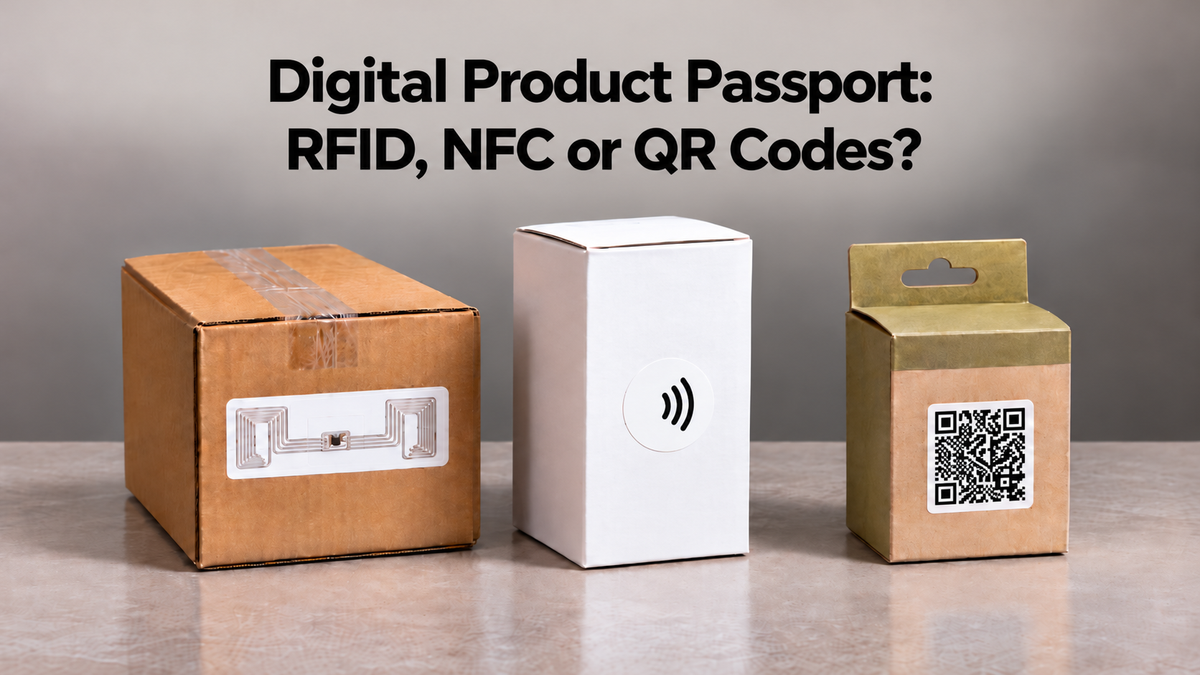
UHF vs HF and NFC: Which Frequency Fits the Application?
RFID comes in various frequency types, such as LF, HF, and UHF, each serving its own purpose.
Low-frequency RFID is what people use when they need to identify things that are close by. They also use it to tag animals and control who gets in and out of a place. High-frequency RFID is used for things like cards and tickets. You will also see it in libraries. When people need to identify items that are near them. Ultra-High-Frequency RFID is better for businesses because it can read things from far away. This makes Ultra-High-Frequency RFID very useful for various uses.
The main advantages of UHF RFID labels over HF and LF include:
-
Longer read range
-
Faster bulk scanning
-
Better fit for warehouse and supply chain operations
-
Suitable for item, carton and pallet-level tracking
-
Strong ecosystem of readers, antennas and software
-
More scalable for large deployments
This does not imply that UHF is always the preferred technology. LF or HF may be better options when there is a need for extremely short distances or in applications involving certain material types or security concerns.
However, in many cases where European companies seek to enhance inventory tracking, logistics, and visibility of assets, RFID labels with UHF technology are the optimal option.
How to Choose the Right UHF RFID Label?
The selection of the appropriate UHF RFID label requires considerations besides cost alone. In order to select the right label for use, certain important factors need to be taken into account.
The following are some critical considerations for EU organisations to consider before procurement.
1. Match the label to the surface
First, look at the material that the label is going to adhere to. This is because paper, plastic, cardboard, glass, fabric, and metal each react differently to labels. If the item is made from metal, you should try using an on-metal RFID tag.
2. Check EU frequency compatibility
In installations, you need to pick RFID tags and readers that work with the European frequency bands for UHF RFID technology.
The rules say that RFID devices have to work at frequencies between 865 MHz and 868 MHz and also between 915 MHz and 921 MHz, and each of these frequencies has power levels.
If your company does business in areas like Europe, the UK or the US, you have to make sure that what works for RFID tags and readers in one region will also work well in another region for RFID tags and readers.
3. Define the read range
A larger reading distance is not necessarily an advantage. Some uses require extended reading distances from doorways or gates. Other applications may require short-range reading from specific workstations. Before selecting UHF RFID tags, consider where you will read the tag and from what distance.
4. Consider the environment
Is the label going to get hot, wet or touched by chemicals? Will it get dirty with dust? Cleaned with strong cleaners?. Will it get worn out by rubbing against things? A simple paper RFID label might work fine for product packaging. For factories or tough jobs, you might need stronger materials, like metal RFID tags.
5. Think about printing and encoding
Some business applications require RFID labels that are tagged with the text, barcode, logo, serial number or product information. There could be a requirement for EPC encoding to ensure that all UHF RFID labels are encoded with accurate data.
6. Test before scaling
The performance of RFID will depend on factors like the type of tag used, readers, antenna used, software, material of the item to be tagged, and installation setup. It is recommended to test some tags in situ before ordering large numbers.
7. Plan the software connection
The benefit of RFID is achieved by the data collected, making its way to your business systems. Before you begin, figure out if the RFID data needs to be linked to your ERP, WMS, or inventory system.
Conclusion
The use of UHF RFID labels will enable companies in Europe to achieve greater efficiency, accuracy and visibility of their assets, warehouse and entire supply chain. They are perfect solutions for businesses that want to eliminate the need for manual scanning, enhance stock control and manage their items effectively.
Depending on the application, RFID tag selection must take into account the type of item, its surface, environmental conditions and the scanning method being used. In cases where the assets to be tagged are made from metal materials, it's advisable to test on-metal RFID tags rather than standard RFID labels. Larger applications will require EU frequencies as well as encoding and system integration.
The RFID Company BV offers support in terms of RFID labels, RFID on-metal tags, RFID encoding services, RFID printing and RFID deployment advice, among other related aspects.
FAQs
1. What are the applications for UHF RFID labels?
UHF RFID labels are used to track product and asset management, cartons, pallets, tools, equipment and inventory control. UHF RFID labels are popularly used in warehousing, logistics, retail, manufacturing, healthcare and supply chain activities.
2. What is the difference between a barcode and a UHF RFID label?
Barcode scans require direct contact or line-of-sight reading, whereas UHF RFID labels can be scanned wirelessly, with many labels scanned at the same time, depending on system design.
3. Can UHF RFID labels operate with metal substrates?
Normal UHF RFID labels will not be able to operate efficiently on metal. Businesses intending to use RFID on metal surfaces should use metal RFID labels.
4. Can UHF RFID labels function in the European market?
Certainly. UHF RFID labels are widely used by European firms to help with their asset, inventory and warehouse management and supply chain visibility requirements.
5. How can I select a good UHF RFID label?
Consider item surface, reading range, operating environment, printing capabilities and data encoding capabilities when choosing an appropriate UHF RFID label. Always get samples to try out before committing to large purchase volumes.

Share:
What is an RFID key fob? Uses, Benefits & Access Control Systems
RFID Inlay vs RFID tag vs RFID Label: What European Businesses Need to Know