
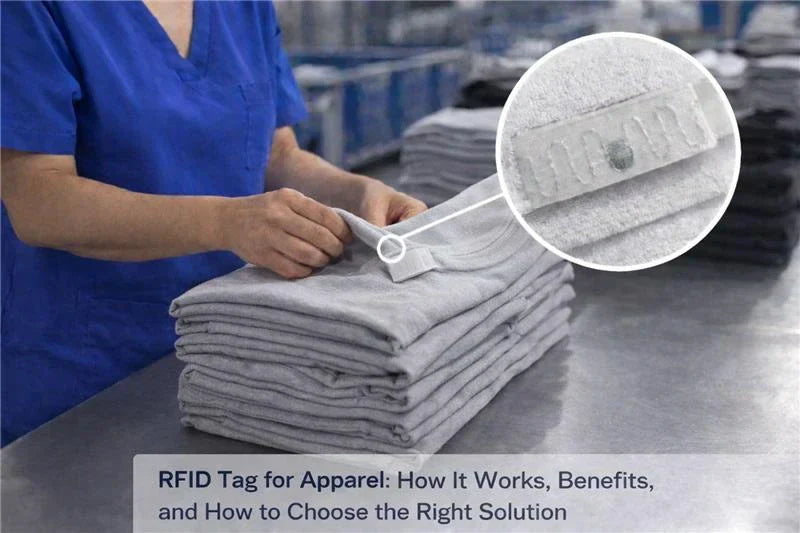
In modern apparel and textile businesses, the pressure is high to act quickly, track efficiently, and minimise losses while avoiding additional manual labour. This is the very reason that the RFID tag for apparel becomes essential in terms of use for apparel manufacturers, retailers, uniform suppliers, and commercial laundries. Instead of relying solely on bar codes and manual counting, RFID allows for more efficient identification and tracking of garments.
With RFID technology, companies can gain better insight and transparency at the item level in such processes as inventory control, stock transfer, laundry management, and garment lifecycle tracking. This is particularly relevant when considering the repeated processing, storage, washing, sorting, and dispatching.
The discussion about apparel RFID tags has expanded beyond retail. Nowadays, the topic expands to include such industries as workwear, uniforms, healthcare textiles, hospitality linens, rentals, and reusable garments. Using RFID clothing tags and RFID laundry tags will allow the team to track inventory status and frequency of garment processing and recycling.
What is an RFID Tag for Apparel?
An RFID tag for apparel is a small label embedded with a chip and antenna that stores a unique identifier. When the label passes near an RFID reader, the system captures that data without taking direct line-of-sight scanning. This is one of the most significant differences between RFID and traditional barcodes.
Within the apparel sector, RFID tags can be incorporated within label materials, sewn in place within garments themselves, heat-sealed to the textile, or even mounted in such a way that suits the material and usage scenario. The format that should be chosen ultimately depends on how the article will be used, such as requiring an RFID label for a garment in the retail environment that differs from a scrub used in hospitals, linen goods in hotels, or uniforms used by workers in manufacturing plants that must withstand regular launderings.
This is where RFID clothing tags and textile-grade RFID solutions become important. These do not simply function to recognise a single object once, but they may be required to withstand continued usage, handling, and, in some instances, heat, chemical resistance, and industrial laundering cycles. Specifically, The RFID Company offers a laundry tag range based on wash durability, heat resistance, heat-seal and sewing mount options, and an IP68 waterproof rating.
Why Apparel Businesses Are Using RFID

Movement is a key part of apparel companies. Products are delivered, stocked, selected, shipped, sold, returned, cleaned, repaired, resold, or repackaged. If such activity occurs on an extensive scale, manual systems lead to gaps.
An effective RFID tag apparel system allows businesses to eliminate such gaps by assigning each individual product a unique identity. This enables quick tracking of products and decreases the duration of searches for lost items.
Some of the most frequently reported reasons businesses use RFID for apparel management include:
1. Better inventory visibility
RFID helps teams understand what they have, where it is, and how fast it is moving.
2. Faster stock counts
Multiple tags can be read quickly, which reduces the labour required for manual checks.
3. Reduced item loss
When garments and textiles are tracked at the item level, it becomes easier to spot shrinkage, misplacement, and unexplained losses.
4. Improved operational control
RFID supports better process tracking across receiving, storage, distribution, and returns.
5. Better lifecycle tracking
For reusable garments and textiles, RFID can support usage history, washing cycles, and replacement planning.
These benefits are particularly important in places like hotels, hospitals, and uniform services, where durable RFID tags are used to keep track of uniforms, towels, bed sheets, and other reusable items during washing, drying, folding, and distribution.
RFID Clothing Tags vs Traditional Labels
While traditional labels can aid in identification, there are limitations to using them when visibility is required immediately. The bar code label, for instance, will require scanning one at a time and should be readable by the scanner.
In contrast, RFID clothing tags have the distinct features that make them more efficient than traditional labels. These include the ability to scan many tags at once without the need for a clear line of sight, among others.
That does not mean every apparel business needs the same RFID setup. The right choice depends on factors such as:
-
Garment type
-
Reading distance required
-
Whether the item is single-use or reusable
-
Exposure to washing, heat, pressure, or chemicals
-
Attachment method
-
System integration needs
For businesses handling reusable apparel or textile assets, durable laundry tags are often a better fit than standard apparel labels because they are built for repeated industrial processes.
How Laundry Tags Support Apparel Tracking

In the case of clothing that undergoes numerous wash cycles, the tag will not only be there to provide identification but also readability through harsh situations. It is at this point that laundry tags take on another function from regular garment labels.
The laundry tags have been manufactured to meet the harsh demands of the textile industry environment, where clothing is regularly laundered, dried, folded, and distributed. RFID laundry tags are intended for linen and textile management purposes, and they can be differentiated according to their washing ability, heat tolerance, attachment, and application.
This issue is important in operations relating to apparel because an RFID tag designed for apparel use must be compatible with the actual conditions that the clothes undergo. For instance, if an apparel item, such as a uniform, is subjected to industrial laundering, it may not perform well under such conditions.
Good RFID clothing tags for washable textile applications are typically selected based on:
-
Wash and heat resistance
-
Chemical exposure tolerance
-
Flexibility and comfort
-
Secure attachment method
-
Read performance in real operational conditions
-
Compatibility with existing RFID infrastructure
Common Mistakes to Avoid
When businesses first explore RFID clothing tags, they often focus only on the tag itself. In reality, successful RFID depends on the full setup.
Here are a few mistakes to avoid:
-
Choosing a tag based only on price
-
Ignoring wash or heat exposure
-
Selecting the wrong attachment method
-
Failing to test read performance on actual garments
-
Overlooking software integration requirements
-
Treating retail apparel, RFID, and laundry RFID as identical use cases
A durable RFID tag for apparel should be selected based on the full operating environment, not just catalogue specifications.
Frequently Asked Questions
What is an RFID tag for apparel?
It is a smart tag used to identify and track garments through RFID technology.
What are RFID clothing tags used for?
They are used for garment tracking, inventory visibility, laundry processing, and uniform management.
Are laundry tags washable?
Yes, durable laundry tags are designed to withstand repeated wash cycles and textile processing conditions.
Who uses RFID tags for apparel solutions?
Retailers, hospitals, hotels, uniform providers, and commercial laundries commonly use them.
How do RFID clothing tags help businesses?
They improve visibility, reduce manual work, support faster counting, and help lower item loss.


Share:
How RFID Tags Are Transforming Retail in Europe (2026 Guide)
What is an RFID key fob? Uses, Benefits & Access Control Systems